

In-Person Mental Health Training for First Responders
An instructor-led program delivered live to your organization, in-person or online via webinars. The same evidence-informed BOS curriculum, built for the classroom.
Designed for the classroom, in-person or via online webinar
Flexible scheduling built around your organization's needs
Ideal for new recruits, peer support groups, and existing cohorts
NOTE: Organization sign-ups only. BOS Classroom is booked at the organizational level and is not available for individual enrollment. For individual training, see BOS On Demand.
Tools and Skills Your Team Will Build with BOS Classroom
BOS Classroom brings the full BOS curriculum to life in a shared group setting. Participants learn together, which opens conversations about operational stress that rarely happen in other formats. The result is not just individual skill-building, but a shift in team culture around mental health.
-
Learn how operational stress disrupts communication and help your team develop practical skills that improve working relationships and reduce conflict, both on the job and at home.
-
Build the ability to identify emotional triggers, interrupt unhelpful thought patterns, and manage stress responses under pressure in a high-demand work environment.
-
Understand how your body and mind respond to operational stress, and develop the self-awareness to notice what is happening before it becomes a problem.

Proud Partners
Trusted by fire departments, law enforcement agencies, and institutions across North America.




Built by Certified
Clinicians
BOS Classroom is facilitated by certified BOS instructors and developed by a team of clinical psychologists with deep knowledge in operational stress, trauma, and frontline mental health. The same curriculum that underpins BOS On Demand, delivered live.

Take a Look Inside
Eight modules, delivered live by a certified BOS facilitator. Each builds on the last, covering the full spectrum of operational stress from physiology to communication to long-term resilience.
-
The first module establishes group expectations and defines operational stress, operational stress injuries (OSIs), compassion fatigue, moral injury, and other terms relevant to the mental health of public safety personnel. It includes an overview of the history of Stoic service culture, when stoicism can be helpful, and when it can be harmful. Functional Disconnection and Reconnection (FD/FR) is introduced as a mechanism through which frontline workers can take an active role when they transition between their occupational and personal identities.
-
The second module discusses brain development, focusing on how the stress response has evolved to support survival. The module centers on the autonomic nervous system, its sympathetic and parasympathetic branches, hormonal dysregulation, and the impact chronic stress can have on the brain over time.
-
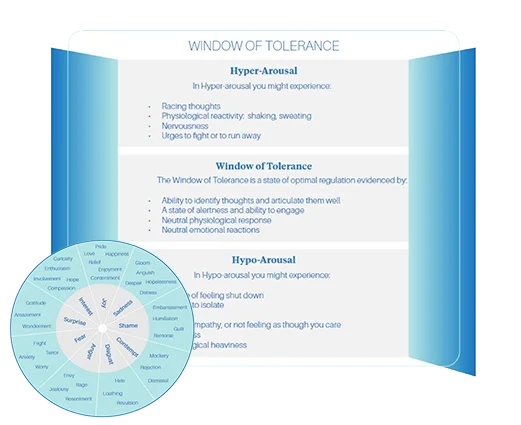
The third module focuses on how unprocessed trauma impacts the nervous system, especially in terms of dysregulation of the stress response. Participants learn how operational stress injuries can sometimes manifest in hypo- or hyper-arousal of the nervous system. The Window of Tolerance is introduced as a self-monitoring and self-awareness tool that participants can apply in their daily lives.
-
The fourth module highlights the connections between thoughts, behaviors, and emotions through a discussion of automatic thoughts, cognitive distortions, and cognitive biases. Participants learn practical ways to monitor their own thinking and disrupt unhelpful thought patterns when they arise.
-
The fifth module is about increasing emotional awareness, including describing the purpose of emotions, and helping participants understand how emotions help make sense of experience. Cultural and societal influences on emotional expression are discussed, followed by an examination of how cultural expectations in frontline environments can lead to the suppression of emotions labelled as unacceptable.
-
The sixth module focuses on the role of avoidance in maintaining anxiety and post-trauma reactions, and how avoidance can interfere with the natural recovery process. The ideas of habituation and in vivo exposure are also introduced. Gradual exposure is proposed as a way to reduce problematic avoidance behaviours, with discussion of engagement strategies to increase self-efficacy.
-
The seventh module discusses how operational stress can negatively impact communication patterns, both at work and at home. Key communication skills are presented to enhance interpersonal understanding, reduce conflict, and help participants navigate difficult conversations more effectively.
-
The eighth and final module explores how empathy can be both a strength and a vulnerability in frontline careers. Functional Disconnection and Reconnection (FD/FR) is revisited as a strategy to balance that paradox. Participants are encouraged to identify specific strategies they’ll use to facilitate healthy transitions between their occupational and personal identities.
Looking for Free Mental Health Resources for Your Organization?
Try these proven strategies to support your team’s mental health for free before enrolling in the full program.
Active Relaxation Skills | 5-4-3-2-1 Grounding Exercise | Combatting Distortions | Catastrophic Thinking Guide | FD/FR Strategies

200+
COMPANIES ONBOARDED
From small agencies to large departments across North America.
100%
EVIDENCE-INFORMED TRAINING
Every module is grounded in clinical psychology and resilience science.
74,000
FIRST RESPONDERS HELPED
Firefighters, officers, paramedics, and frontline workers are better equipped with BOS.

Hear from real first responders about how Before Operational Stress enhances their resilience, access to social support, and quality of life.
“Sunt culpa officia deserunt mollit anim laborum omnis natus voluptatem accus antium dolor emrue totam aperiam earue illo inventore veritatis beatae vitae dicta explicabo enim ipsam volup tatem voluptas asper natur fugit nerue ipsum..”
MICHAEL GEORGESON – SAMPLE CO.
Frequently Asked Questions
Everything you need to know about BOS Classroom before you get started.
-
BOS Classroom is an instructor-led group training program that delivers the evidence-informed BOS curriculum live to organizations, departments, and agencies. It can be facilitated in person or via an online webinar, with flexible scheduling to fit your organization's needs. Unlike BOS On Demand, which is self-paced and individual, BOS Classroom is a shared experience where participants learn together under a certified BOS facilitator.
-
No. BOS Classroom is available for organizational sign-ups only. It’s designed to be delivered to a department, agency, team, or cohort as a group. If you’re an individual looking to complete BOS training on your own, BOS On Demand is the right option. It covers the same eight-module curriculum and is available to purchase immediately for $200.
-
There’s no cap on the total number of participants. However, the delivery format varies with group size. With up to 25 participants, BOS Classroom is delivered in an interactive format with discussion and group engagement. With more than 25 participants, the program shifts to a lecture-style format. For organizations with very large cohorts, multiple sessions can be scheduled to maintain the interactive experience.
-
BOS Classroom covers eight modules over approximately eight hours of contact time. Scheduling is fully customizable. Sessions can be structured as a full-day program, split across multiple half-days, or arranged around shift schedules and operational timelines. We work with your organization to find the format that creates the least disruption while delivering the full curriculum.
-
No. BOS Classroom is a psychoeducational training program, not a clinical intervention. It’s designed for prevention and resilience-building at the organizational level. For teams or individuals who need a higher level of clinical support, BOS Intensive is an eight-week program that includes psychological therapy delivered by BOS-trained clinicians.
-
BOS Classroom is facilitated by certified BOS instructors trained by the Wayfound clinical team. The BOS curriculum was developed by Dr. Megan McElheran, Dr. Lawrence Deck, Dr. Andrew Carlquist, Alanna Caldwell, and Lucia Antonucci, all registered psychologists with vast expertise in operational stress and frontline mental health.
-
Both programs cover the same eight-module BOS curriculum. The core difference is format and audience. BOS On Demand is a self-paced online program for individuals who want flexible training they can complete anywhere, on their own schedule. BOS Classroom is a live, instructor-led group program designed for organizations that want to train a team together. The shared experience of BOS Classroom often produces a shift in team culture around mental health that individual training alone cannot replicate.
-
Fill out the inquiry form on this page, and a member of the BOS team will follow up to discuss your organization's needs, including group size, preferred format, scheduling, and pricing.