
Evidence-Based Mental Health Training for First Responders
A research-backed overview of the BOS program, its outcomes across three delivery formats, and what it means for public safety personnel and first responders.
44.5%
of Canadian public safety personnel screen positive for at least one mental health disorder. [7]
ABOUT THIS REPORT
Why this report exists, and where its evidence comes from
Why This Report Exists
Public safety personnel (PSP) and first responders face mental health risks beyond those of the general population, yet many remain unaware of proactive programs designed to address those risks before harm occurs.
This report gathers and presents independent, peer-reviewed evidence on the Before Operational Stress (BOS) program — so organizations can make informed decisions about bringing proactive mental health training to their teams.
Who It’s For
Fire, police, paramedic, corrections, military, and healthcare leaders evaluating proactive mental health training
Wellness and peer-support coordinators
Frontline professionals considering training for themselves
Where the Data Comes From
Every statistic is drawn from peer-reviewed research published between 2021 and 2025 — including four independent evaluations of BOS led by researchers at CIPSRT, University of Regina, plus two foundational framework papers.
Background figures on the scale of the problem come from large national studies of Canadian PSP and nurses. Sources are numbered throughout and listed in full at the end.
Why It Matters
Most resilience programs are delivered once, after a crisis, and are never measured.
BOS was built to do the opposite: to prepare people proactively, early in their careers, and to be held to the standard of independent evidence. What follows is that evidence.
SECTION 01 · THE PROBLEM
The crisis facing public safety and healthcare workers
PSP, first responders, and healthcare workers face repeated exposure to traumatic events. They also screen positive for mental health disorders at roughly four to five times the rate of the general population.
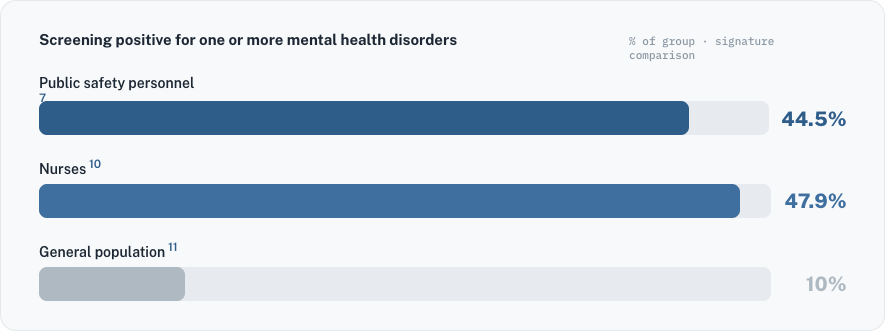
Evidence suggests that exposure to trauma is a contributing risk factor. PSP and nurses report experiencing a potentially traumatic event an average of 11 or more times over a career, while most people in the general population encounter fewer than five such events in an entire lifetime.
11+
potentially traumatic events over a career — PSP & nurses, on average. [9]
<5
such events in an entire lifetime — general population, typically. [13,14]
The human toll: trauma and suicide risk
Among Canadian public safety personnel, lifetime rates of suicidality are sobering:
Canadian healthcare providers reported worsening mental health since the onset of the COVID-19 pandemic. [12]
27.8%
Suicidal ideation [8]
4.6%
Attempted [8]
13.3%
Made a plan [8]
7 in 10
SECTION 02 · THE GAP
Existing approaches aren’t enough
The problem is that most mental health support for people in these professions arrives too late and too thin. BOS was designed to fill this specific, well-documented gap.
Reactive, not proactive.
Many resilience programs are delivered as a single session after a critical event, with no structured follow-up. [3]
Thinly evidenced.
The evidence base for proactive mental health training in this sector is limited, and many previously existing programs showed only small, short-term effects. [5]
Not built for the culture.
PSP consistently report that existing supports feel insufficient for their needs, and have asked for programs tailored to their occupational culture.
Stoicism with no off-switch.
Traditional stoicism forms the cultural backbone of most North American public safety organizations. The emotional suppression it encourages can become harmful when carried into personal life. [1]
THE TYPICAL MODEL
A single reactive session after a critical event — no follow-up.
WHAT’S NEEDED
The evidence base for proactive mental health training in this sector is limited, and many previously-existing programs showed only small, short-term effects. [5]
Strong minds train first.
SECTION 03 · THE SOLUTION
What is Before Operational Stress?
BOS is an evidence-informed proactive mental health training program built specifically for public safety personnel and, more recently, military members and healthcare workers.
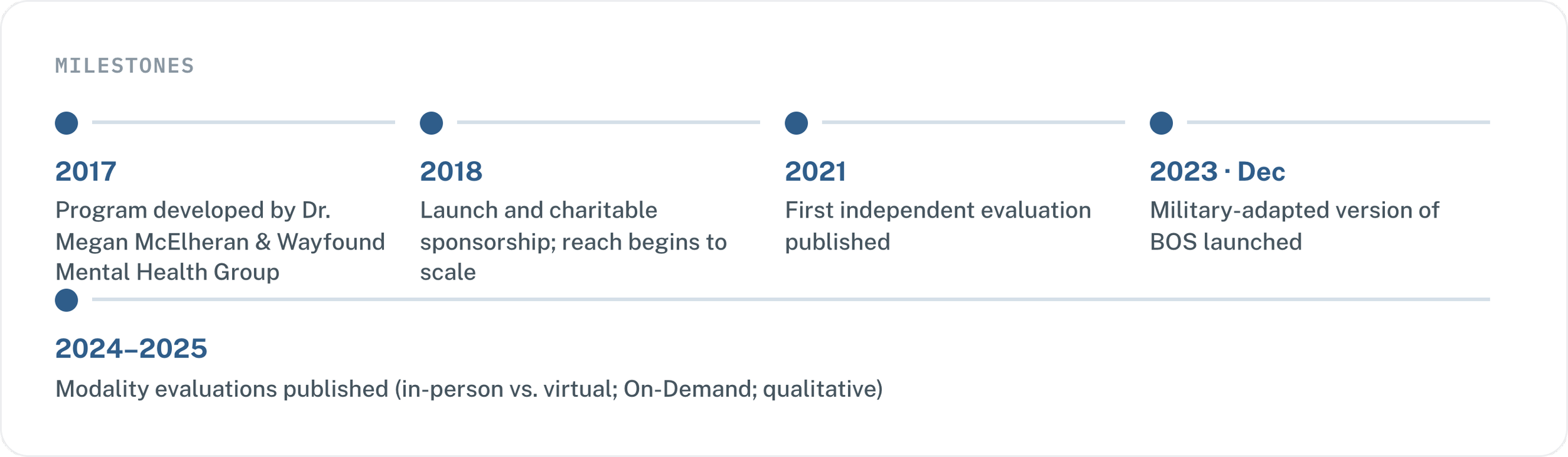
Developed in 2017 by Dr. Megan McElheran and Wayfound Mental Health Group, it draws on cognitive behavioural therapy and group therapeutic techniques to build resilience before operational stress takes its toll — not after. [3,5,6]
The program runs over eight weeks across eight modules. The first six help participants understand and navigate the connections between their thoughts, emotions, physical sensations, and behaviours; the final two focus on communication and relationships. [3,4,5,6]
Developed 2017 · Dr. Megan McElheran & Wayfound Mental Health Group
Expert-facilitated (in person or online)
Available in English & French
The eight-week structure
Weeks 1–6 understanding the self · Weeks 7–8 relationships & transition
-
Establishes a shared vocabulary for operational stress, operational stress injuries, compassion fatigue, and moral injury. Traces the history of stoicism in service culture, including when it helps and when it harms. Introduces Functional Disconnection/Reconnection as a way to take an active role in shifting between work and home.
-
Explains how the stress response evolved to keep us alive, covering the autonomic nervous system and its sympathetic and parasympathetic branches. Participants learn how chronic stress and hormonal dysregulation actually change the brain and body over time.
-
Shows how unprocessed trauma dysregulates the nervous system, reframing operational stress injuries as a form of that dysregulation rather than a personal failing. Participants learn to use the Window of Tolerance as a practical self-monitoring tool for recognizing hyper- and hypo-arousal.
-
Draws connections between thoughts, emotions, and behaviours through the lens of automatic thoughts, cognitive distortions, and cognitive biases. The focus is on noticing unhelpful thinking patterns and learning concrete ways to interrupt them.
-
Builds emotional awareness by exploring what emotions are for and how they help us make sense of our experiences. Participants examine how cultural and workplace expectations can push people to suppress emotions they've been taught are unacceptable.
-
Examines the role avoidance plays in sustaining anxiety and reactions to trauma, and how it quietly interferes with recovery. Introduces gradual exposure and habituation as practical strategies for reducing avoidance and rebuilding a sense of self-efficacy.
-
Addresses how operational stressors and common reactions to them can erode communication with the people closest to us. Participants build key communication skills to strengthen understanding and connection in their personal and professional relationships.
-
Explores empathy as both a strength and a vulnerability across a career, and revisits FD/FR as the strategy for managing that paradox. Participants identify specific skills and values they'll draw on to move intentionally between their operational and personal identities, and leave with a concrete plan for putting FD/FR into practice.
The engine: Functional Disconnection / Reconnection
At the heart of BOS is a peer-reviewed model called Functional Disconnection and Functional Reconnection (FD/FR), published in the European Journal of Psychotraumatology. FD/FR teaches how to intentionally shift into an operational mindset when duty calls, and deliberately back out of it when returning to personal life — rather than carrying suppressive coping home. [1]
FD/FR is grounded in Stoic philosophy — the Dichotomy of Control, Amor Fati — traditions already woven into military and public safety culture. That cultural fluency helps the framework resonate with participants, whereas conventional therapeutic approaches sometimes don't. [1,2]

SECTION 04 · THE EVIDENCE
What the research shows
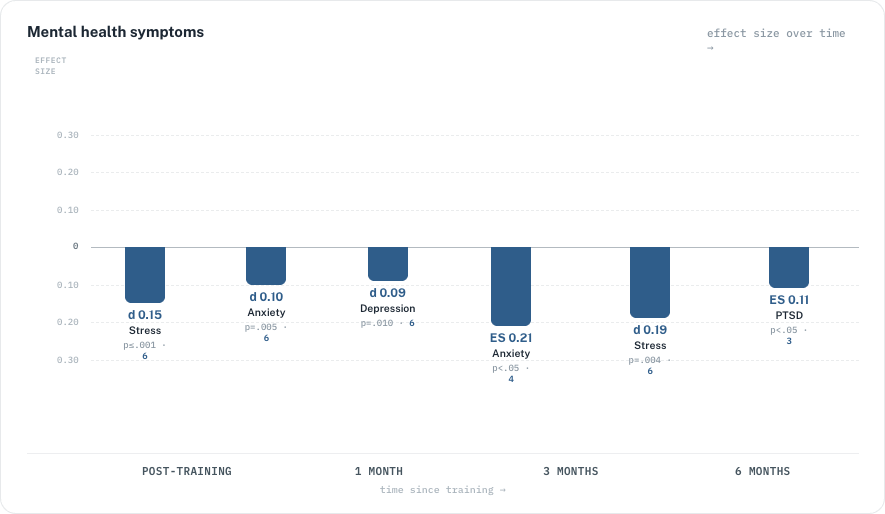
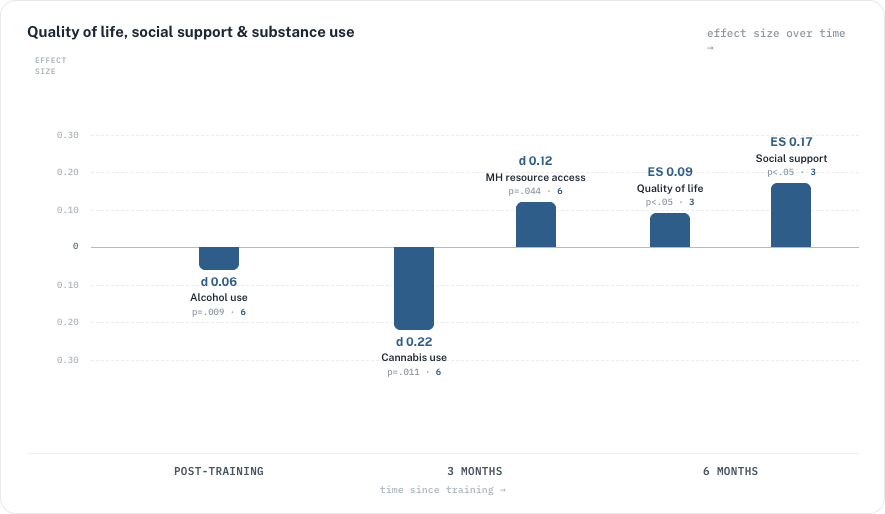
Four independent evaluations have measured BOS against self-reported mental health outcomes. The effects are consistently described in the research as statistically significant — a meaningful and realistic result for a brief, proactive training program that holds up across multiple studies and delivery formats.
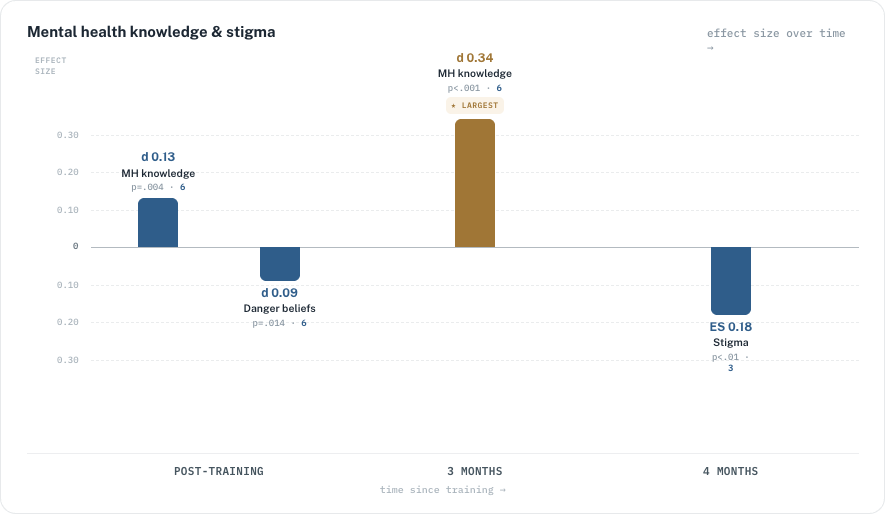
STANDOUT FINDING
d 0.34
Gain in mental health knowledge at 3 months — the largest effect in the BOS literature to date (a moderate effect). It strengthened from post-training (d 0.13) to follow-up; that direction of travel is the story. [6]
How to Read These Charts
Effect size (Cohen's d / ES) — how big the change is. As a rule of thumb, ≈0.2 is small, ≈0.5 medium, ≈0.8 large. Bar length shows this; BOS effects are mostly small but consistent.
p-value — the likelihood a result is down to chance. p<.05 counts as statistically significant; the smaller the number, the stronger the evidence.
Up vs. down — bars rising above the centre line mean the measure increased (e.g. knowledge); bars below mean it decreased (e.g. stress, stigma). Either way, every bar shown is an improvement.
The bar highlighted in orange represents the largest effect in the BOS literature. The y-axis uses one honest scale across all four charts, so bar heights are directly comparable.
SECTION 05 · ACCESSIBILITY
BOS works across all three formats
BOS is available in three different formats:
Intensive (in-person)
Classroom group sessions (virtual or in-person)
Fully self-paced (On-Demand).
Evidence shows that each available format is associated with statistically significant outcomes. [3, 4, 6]
BOS Intensive
In-person, facilitated
Stress/anxiety improvements
Mental health knowledge gain
Effects sustained at follow-up
BOS Classroom
Virtual or in-person group
Stress/anxiety improvements
Mental health knowledge gain
Effects sustained at follow-up
Fully self-paced
BOS On-Demand
Stress/anxiety improvements
Mental health knowledge gain
Effects sustained at follow-up
Virtual delivery of the BOS program (Classroom) was found to be an accessible mental health training option for PSP that produces comparable effects to in-person delivery by clinicians. [4]
Self-paced delivery (On Demand) also produced improvements that were sustained at follow-up, including decreased stress and increased mental health knowledge. [6]
9,295
participants enrolled in the On-Demand evaluation — the largest BOS study to date. [6]
81.6%
completed at the recommended 1–2 modules per week. [6]
Whichever format fits your people, the evidence holds.
SECTION 06 · LIVED EXPERIENCE
What participants say
The numbers point to the results of BOS training, but the actual impact can only be described by the participants. In an in-depth pan-Canadian study, 41 PSP and healthcare workers were interviewed at length about completing BOS. Their accounts, alongside the near-universal verdict from the earlier evaluation, help put a human face on the data.
100%
of qualitative respondents found the program helpful or beneficial. [3]
83.1%
of On-Demand participants rated BOS "very" or "extremely important" at 3 months. [6]
AMONG THE 41 INTERVIEWED PARTICIPANTS
63%
gained practical tools to support their own health [5]
63%
felt permission to talk about mental health, reducing self-stigma [5]
59%
reported greater self-awareness of their mental health needs [5]
59%
learned self-care and how to set boundaries [5]
49%
said BOS helped normalize mental health conversations at work [5]
34%
were still using the Window of Tolerance tool [5]
32%
better understood and managed their emotions [5]
“I have been able to recognize certain emotions as they are occurring and work through them, instead of just becoming angry because I did not understand the emotion.”
— BOS participant [3]
SECTION 07 · DURABILITY
The clearest sign a program works is what people keep doing after it ends. Among On-Demand participants, use of BOS skills didn't fade after training — it grew, in several cases dramatically, by the three-month mark. [6]
Skills that stick
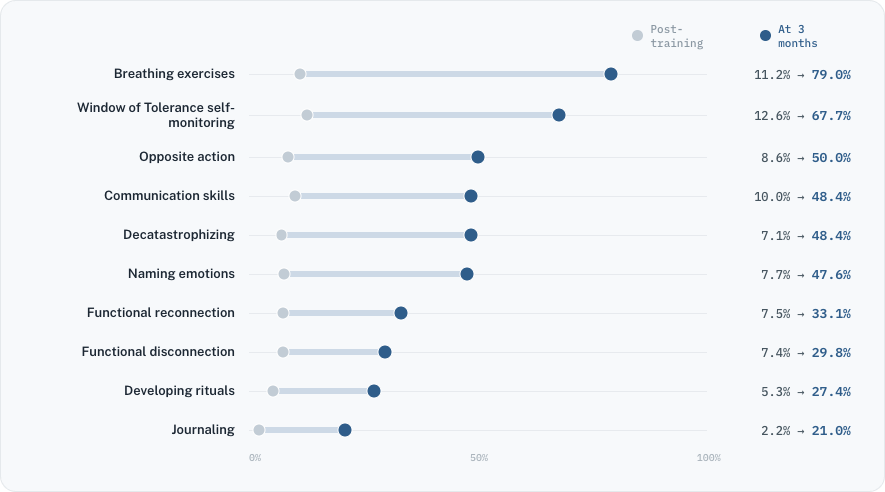
39.5% → 47.6%
Use of breathing exercises rose from 11.2% to 79.0%, and journaling from 2.2% to 21.0% — both statistically significant (p<.001). Overall, weekly use of BOS skills climbed from 39.5% right after training to 47.6% three months later. [6]
SECTION 08 · BROADER IMPACT
Beyond the individual: the community effect
When one person learns to manage operational stress, the benefit rarely stops with them. Researchers documented what they called a "ripple effect of helping": skills moving outward from each individual to their family, colleagues, and others within their organization.
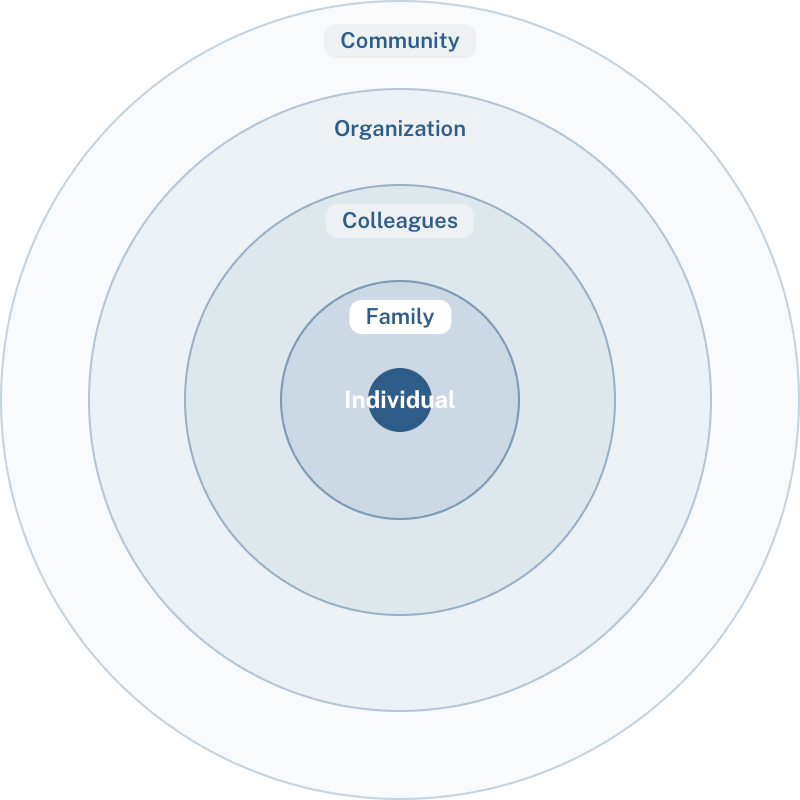
The FD/FR framework was built to be folded into existing training and organizational culture rather than as a standalone program. This can make it easier for organizations to adopt. [1]
63%
described BOS as valuable for their colleagues and family, as well as themselves. [5]
That outward pull is intentional among some participants: many took BOS specifically to be better equipped to support others.
11
11
in formal or informal peer-support roles [5]
in mentorship or wellness-committee roles [5]
Individual training works best alongside organizational change
56%
of interviewed participants also identified organizational stressors — staffing shortages, contradictory policies, or under-resourcing — as barriers to applying what they learned. This highlights the need for organizations to prioritize and support proactive mental health training, not merely adopt it. [5]
SECTION 09 · SCALE & REACH
Scale, reach, & what’s next
BOS is no longer a pilot. It is an established, independently evaluated, and growing national program.
70,000+
Canadians in high-risk professions reached since 2018. [2]
Program's current self-reported figure: 74,000+ — an increase from the peer-reviewed count.
4+2
Four peer-reviewed program evaluations, plus two foundational framework papers. [1–6]
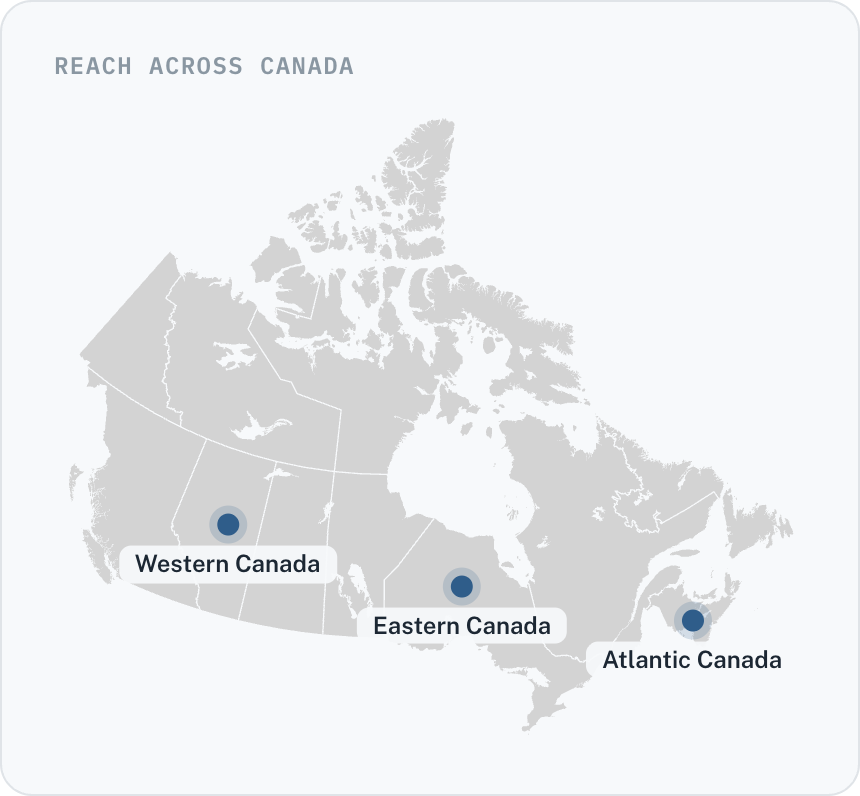
All three delivery formats have now been independently evaluated by researchers at CIPSRT, University of Regina, and BOS is available across Western, Eastern, and Atlantic Canada in both English and French. [3,4,5,6]
GET STARTED
Take the first step—before operational stress does.
Strong minds train first. Whether you're equipping a single team or an entire organization, BOS meets your people where they are: in person, in a virtual group, or fully self-paced.
BOS On-Demand
Self-paced, individual access. Start anytime, anywhere.
BOS Classroom
Virtual facilitated groups.
BOS Intensive
In-person groups.
Explore all programs at beforeoperationalstress.ca
Contact the BOS team: bosadmin@wayfound.ca
[1] McElheran, M., & Stelnicki, A. M. (2021). Functional disconnection and reconnection: an alternative strategy to stoicism in public safety personnel. European Journal of Psychotraumatology, 12(1), 1869399. https://doi.org/10.1080/20008198.2020.1869399
[2] McElheran, M., Annis, F. C., Duffy, H. A., & Chomistek, T. (2024). Strengthening the military stoic tradition: enhancing resilience in military service members and public safety personnel through functional disconnection and reconnection. Frontiers in Psychology, 15, 1379244. https://doi.org/10.3389/fpsyg.2024.1379244
[3] Stelnicki, A. M., Jamshidi, L., Fletcher, A. J., & Carleton, R. N. (2021). Evaluation of Before Operational Stress: A program to support mental health and proactive psychological protection in public safety personnel. Frontiers in Psychology, 12, 511755. https://doi.org/10.3389/fpsyg.2021.511755
[4] Ioachim, G., Bolt, N., Redekop, M., Wakefield, A., Shulhin, A., Dabhoya, J., Khoury, J. M. B., Bélanger, K., Williams, S., Chomistek, T., Teckchandani, T. A., Price, J. A. B., Maguire, K. Q., & Carleton, R. N. (2024). Evaluating the Before Operational Stress program: Comparing in-person and virtual delivery. Frontiers in Psychology, 15, 1382614. https://doi.org/10.3389/fpsyg.2024.1382614
[5] Ioachim, G., Allen, L., Redekop, M., Khan, A., Khoury, J. M. B., Maguire, K., & Carleton, R. N. (2025). A qualitative evaluation of the Before Operational Stress program: A pan-Canadian study of mental health training for frontline public safety personnel and healthcare providers. Stress and Health, 41, e70091. https://doi.org/10.1002/smi.70091
[6] Ioachim, G., Bolt, N., Bélanger, K., Shulhin, A., Dabhoya, J., Khoury, J. M. B., Teckchandani, T. A., Shields, R. E., Maguire, K., & Carleton, R. N. (2025). Evaluating the Before Operational Stress on-demand asynchronous online training for public safety and healthcare personnel. Mental Health & Prevention, 40, 200459. https://doi.org/10.1016/j.mhp.2025.200459
[7] Carleton, R. N., Afifi, T. O., Turner, S., Taillieu, T., Duranceau, S., LeBouthillier, D. M., . . . Asmundson, G. J. G. (2018). Mental disorder symptoms among public safety personnel in Canada. The Canadian Journal of Psychiatry, 63(1), 54–64. https://doi.org/10.1177/0706743717723825
[8] Carleton, R. N., Afifi, T. O., Turner, S., Taillieu, T., LeBouthillier, D. M., Duranceau, S., . . . Asmundson, G. J. G. (2018). Suicidal ideation, plans, and attempts among public safety personnel in Canada. Canadian Psychology/Psychologie Canadienne, 59(3), 220–231. https://doi.org/10.1037/cap0000136
[9] Carleton, R. N., Afifi, T. O., Taillieu, T., Turner, S., Krakauer, R., Anderson, G. S., . . . McCreary, D. R. (2019). Exposures to potentially traumatic events among public safety personnel in Canada. Canadian Journal of Behavioural Science, 51(1), 37–52. https://doi.org/10.1037/cbs0000115
[10] Stelnicki, A. M., & Carleton, R. N. (2021). Mental disorder symptoms among nurses in Canada. Canadian Journal of Nursing Research, 53(3), 264–276. https://doi.org/10.1177/0844562120961894
[11] Statistics Canada. (2012). Rates of selected mental or substance use disorders, lifetime and 12 month, Canada, household population 15 and older, 2012 (Canadian Community Health Survey – Mental Health). Statistics Canada.
[12] Statistics Canada. (2021). Mental health among health care workers in Canada during the COVID-19 pandemic. The Daily. https://www150.statcan.gc.ca/n1/daily-quotidien/210202/dq210202a-eng.htm
[13] Benjet, C., Bromet, E., Karam, E. G., et al. (2016). The epidemiology of traumatic event exposure worldwide: Results from the World Mental Health Survey Consortium. Psychological Medicine, 46(2), 327–343. https://doi.org/10.1017/S0033291715001981
[14] Kilpatrick, D. G., Resnick, H. S., Milanak, M. E., et al. (2013). National estimates of exposure to traumatic events and PTSD prevalence using DSM-IV and DSM-5 criteria. Journal of Traumatic Stress, 26(5), 537–547. https://doi.org/10.1002/jts.21848