
Case Study: Mental Health in First Responder Training
Summary:
Many paramedics and other first responders finish their training with little preparation for what repeated trauma exposure will do to their mental health. In this first-person account, former critical care paramedic and current Wayfound VP Dillon Brock describes the gaps in his own education, the reality check that followed, and three things Before Operational Stress (BOS) training gave him: a clinical understanding of stress, less stigma and a way to judge his own fitness for duty.
| Time to Read | ~8 minutes |
|---|---|
| What You'll Learn |
|
| Next Steps |
|
Versioned Specifics:
Originally published: October 14, 2026
Key problems addressed: the limits of mental health education in typical paramedic training; common stigma and cultural challenges in professional settings; first responders struggling to judge their own fitness for duty; the staffing cost of psychological injury leave
BOS solutions: BOS On Demand, BOS Classroom, BOS Intensive
What Standard Training for First Responders Covers about Mental Health (& What It Leaves Out)
Whenever I used to tell someone I was a paramedic, one of the first things they’d always ask was: "What's the worst thing you've ever seen?"
If you’ve ever done the same job, I’m guessing you’ve probably had the same thing happen to you. It’s become a running joke in our profession.
Most of us have no desire to relive the most upsetting moments of our careers, so I’m not going to do that here. Instead, I want to talk about something else: how unprepared I was to deal with those situations when I finished paramedic school and started working in the real world.
About the Author
My name is Dillon Brock. I've worked in EMS since 2006, starting as an EMR and eventually working to be on the road as a paramedic and critical care paramedic, and later in EMS leadership and education. Today, I'm the Vice President of Strategic Partnerships and Implementation at Wayfound Mental Health Group, the organization behind Before Operational Stress (BOS).
I've also been through BOS’s proactive mental health training for first responders myself. This is what it gave me that my time in school didn't.
What Paramedic School Taught Me About Wellness
I started training to become a paramedic in Indianapolis in 2008. Like every paramedic, I had to become an EMT first, then I started at the Clarion Health Paramedic Program at Methodist Hospital and subsequently completed my critical care paramedic training at Vanderbilt University.
All programs included a chapter on wellness, but each one essentially presented the same information: eat healthy, exercise, get good sleep and don't lift with your back.
We learned about mental health in a more clinical sense, usually described as a consideration for the patients we would treat. I remember being taught definitions of schizophrenia and other abnormal psychological conditions. But I didn't learn much about what the job would do to my own mental health, or how to protect it.
At the time, I didn't expect more. You don't know what you don't know. When I graduated, I assumed I was prepared for the job ahead of me. I felt confident; in fact, I felt practically invincible. But although I had been taught the necessary skills to perform my work, I hadn’t been taught to handle the everyday stress of the job.
The Reality Check New First Responders Face After Graduation
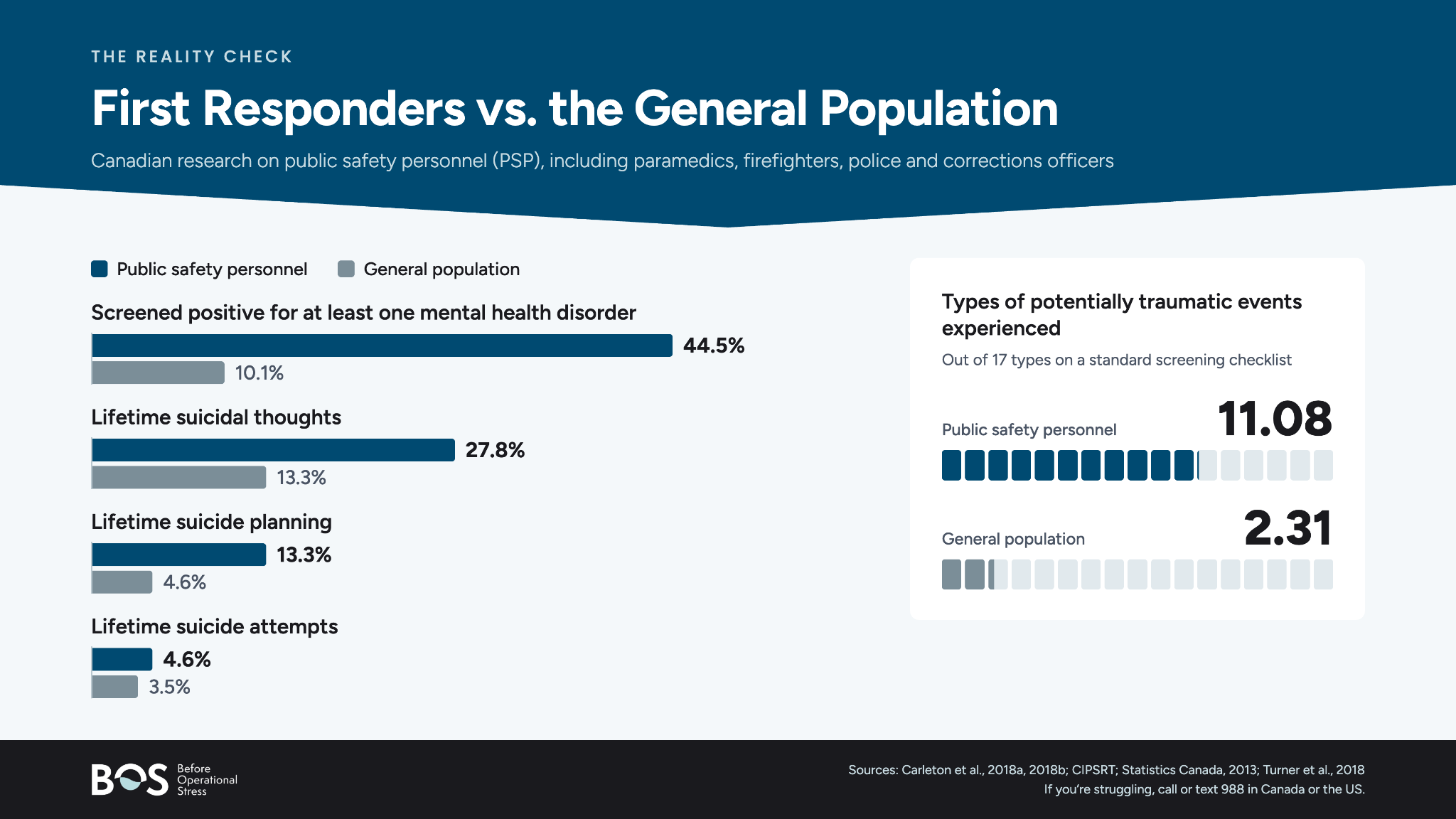
The potentially traumatic situations you encounter as a paramedic are significantly more common than those experienced by the general public. Canadian research on public safety personnel (PSP), including paramedics, firefighters, police and corrections officers, illustrates this difference clearly:
| Measure | Public safety personnel | General population |
|---|---|---|
| Screened positive for at least one mental health disorder | 44.5% | About 10% |
| Types of potentially traumatic events experienced (out of 17) | 11.08 | 2.31 |
| Lifetime suicidal thoughts | 27.8% | 13.3% |
| Lifetime suicide planning | 13.3% | 4.6% |
| Lifetime suicide attempts | 4.6% | 3.5% |
Sources: Carleton et al., 2018a, 2018b; CIPSRT; Statistics Canada, 2013; Turner et al., 2018. Trauma exposure is measured as the number of different types of potentially traumatic events a person has experienced (out of 17 on a standard screening checklist).
It’s true that these are Canadian numbers, and that I worked as an American paramedic. But the core of the job is the same on both sides of the border. After moving to Canada, I have had the pleasure of spending time with many paramedics across the nation. The culture they described to me, the stories they shared, and the conversations we had were completely in line with what I'd known in the US.
For example: In previous times, in many stations, there’s an unspoken rule that open displays of emotion aren't really allowed, other than anger. Despite the amount of trauma we experience, it’s extraordinarily difficult to acknowledge the way that trauma makes us feel without facing stigma from colleagues.
The wellness advice I got in school often didn't hold up on the job, either. On a 24-hour shift, you're staying up throughout the night, and even when it's quiet, you're waiting for a call to come in. Our instructors knew we couldn't get good sleep. They'd say so, everyone would laugh, and then they'd say some version of, "But try your best."
Eating well was the same story. Driving around for 18 hours was a common experience. Most of us didn’t even have enough time at home to pack quinoa or other healthy meals, much less heat them up during work hours. Instead, we found ourselves grabbing fast food and eating it on the way to the next call.
It wasn’t just that the wellness training I received in school was too light. It was that even the limited information we were taught about wellness didn’t apply to the job we were training to do.
But I don't blame my schools. US paramedic education follows national standards set through the Department of Transportation, and every paramedic I have ever met agrees that those standards don't go far enough on mental health. Fortunately, some programs are starting to change. In 2024, SAIT in Calgary became the first post-secondary institution in North America to make BOS a permanent part of its paramedic education.
Three Things Proactive Mental Health Training Gave Me
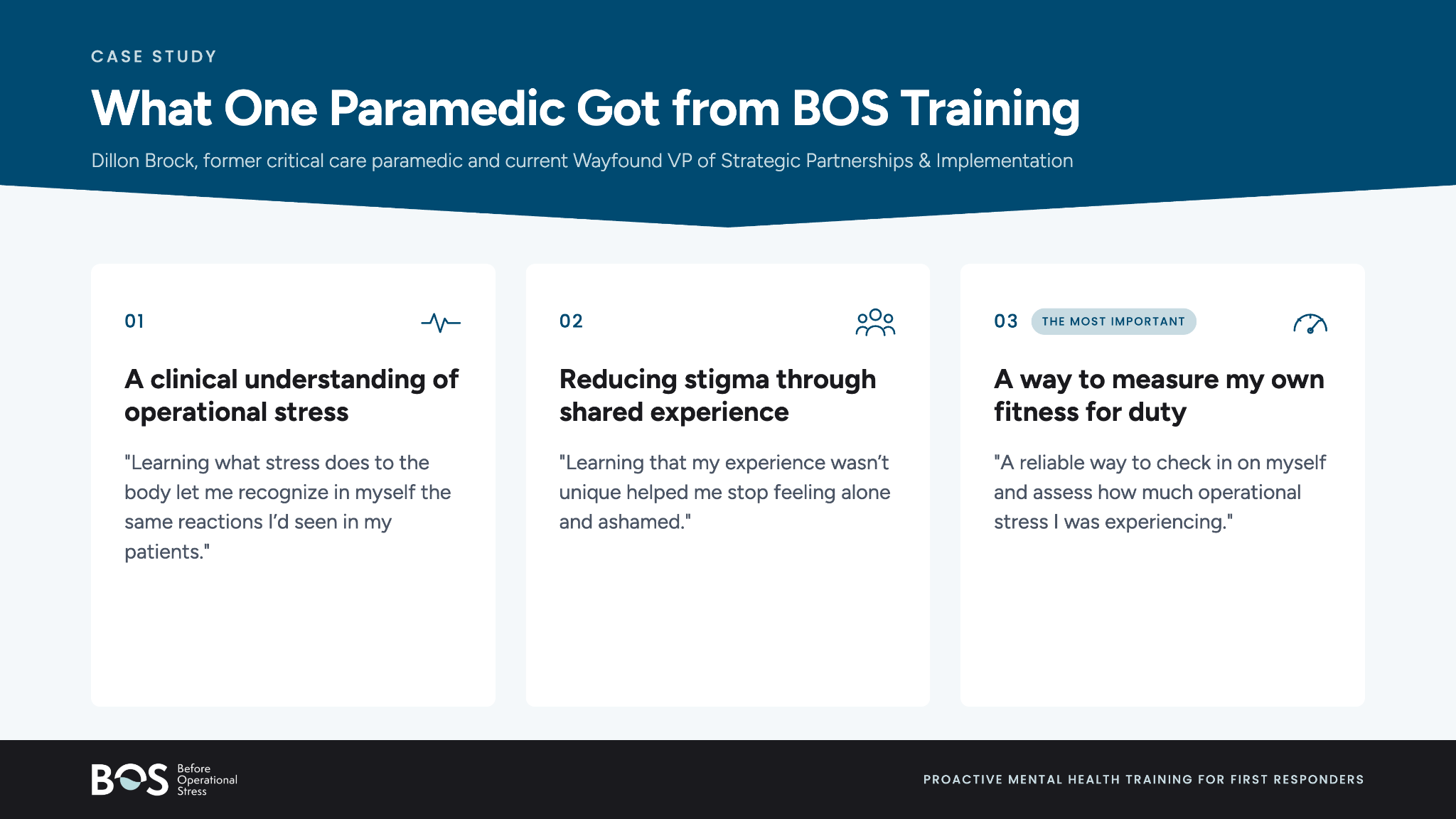
I took the BOS program before I started my work with Wayfound. Its eight modules gave me three things I'd been missing since paramedic school:
A Clinical Understanding of Operational Stress
One of the first and most helpful things BOS training helped me understand was how stress impacts the body.
When something stressful happens, your sympathetic nervous system responds. It doesn't matter how strong or how weak you are. You can't fight it, because it's a natural response to stimulus for every human.
Learning what stress does to the body made it possible for me to recognize the types of reactions I had previously seen in patients in myself as well. I already trusted clinical science on the job. Now I could apply it to my own experience.
That seems to be a common benefit of the training. In research on BOS On Demand, participants' mental health knowledge kept growing for three months after they finished the training. (Ioachim et al., 2025b).
Reducing Stigma Through Shared Experience
Learning to recognize the impacts of stress in myself made me more aware. Learning that my experience wasn’t unique helped me stop feeling alone and ashamed.
Later BOS modules went beyond showing what was scientifically happening to me, and showed me that other participants were in the same boat. We went through the markers of operational stress one by one, from lack of sleep to irritability and beyond. Everyone I was taking the training with was checking them off, laughing and joking about how many of them applied to us on a regular basis. It was profoundly destigmatizing to realize how alike our experiences were.
Research has confirmed the same effect. Mental health stigma dropped among in-person BOS participants and stayed down at follow-up (Stelnicki et al., 2021), and 63% of participants interviewed in a pan-Canadian study said BOS gave them permission to talk about mental health (Ioachim et al., 2025a).
A Way to Measure My Own Fitness for Duty
The third thing BOS gave me is what I consider the most important: a reliable way to check in on myself and assess how much operational stress I was experiencing.
For years, I would go to work assuming that as long as I was able to get up in the morning, I was capable of doing the job. I had no way to gauge how much stress I was under, or how that stress would affect my ability to help the people who were depending on me.
If first responders had some way of knowing they weren’t able to function properly at work, every one of us would call in rather than potentially fail the people who need us. But most of us are never taught where the line is between being fit for duty or not. And since we’re the only ones who can make that call, it’s critical that we have a reliable way to assess ourselves.
After my BOS training, if I hit the threshold I'd been taught to recognize, I knew I could be certain that I needed help. Ultimately, being able to seek that support quickly when necessary meant less time away from work and more time helping the people I had been trained to help.
And my experience wasn’t unique, because those skills tend to stick. Among BOS On Demand participants, weekly use of BOS skills rose from 39.5% right after training to 47.6% three months later (Ioachim et al., 2025b).
Proactive Training Matters for First Responders and Their Leaders
As a result of those three things, here's how my work changed:
Because the training was grounded in clinical science, I could trust what I was learning.
Because the stigma came down, I didn't feel guilt on top of what I was already dealing with.
And because I had a way to measure where I was, I could take care of myself when I needed it—which also helped me take better care of the people my work is supposed to serve.
But these benefits reach beyond individual first responders. If you're the director or manager deciding whether to bring training like this to your team, the ROI comes in the form of consistency. The costs of training your team pale in comparison to having one of your medics out on injury leave for nine weeks, during which you’ll still have to pay them and cover their shifts.
What I Want New First Responders to Know
If you're in paramedic school right now or you’ve recently begun to work in the field, know that I didn’t have access to tools like this early on in my career. But I wish I did.
I'm still not going to tell you the worst thing I've ever seen on the job. What I will tell you is that knowing what those calls were doing to me and having a way to recognize when it was too much made me a happier and better-adjusted person. I would want every new first responder to have that before their first shift.
Explore BOS On Demand to take the program on your own, or contact the BOS team to bring proactive mental health training to your organization.
If you're struggling right now, you don't need to wait for a training program. In Canada or the United States, you can call or text 988 at any time to reach a trained crisis responder.
References
Carleton, R. N., Afifi, T. O., Turner, S., et al. (2018a). Mental disorder symptoms among public safety personnel in Canada. The Canadian Journal of Psychiatry, 63(1), 54–64. https://doi.org/10.1177/0706743717723825
Carleton, R. N., Afifi, T. O., Turner, S., et al. (2018b). Suicidal ideation, plans, and attempts among public safety personnel in Canada. Canadian Psychology/Psychologie canadienne, 59(3), 220–231. https://doi.org/10.1037/cap0000136
Canadian Institute for Public Safety Research and Treatment (CIPSRT). Trauma exposure [research infographic].
Ioachim, G., Allen, L., Redekop, M., et al. (2025a). A qualitative evaluation of the Before Operational Stress program: A pan-Canadian study of mental health training for frontline public safety personnel and healthcare providers. Stress and Health, 41, e70091. https://doi.org/10.1002/smi.70091
Ioachim, G., Bolt, N., Bélanger, K., et al. (2025b). Evaluating the Before Operational Stress on-demand asynchronous online training for public safety and healthcare personnel. Mental Health & Prevention, 40, 200459. https://doi.org/10.1016/j.mhp.2025.200459
Statistics Canada. (2013). Mental and substance use disorders in Canada. Health at a Glance (Catalogue no. 82-624-X). https://www150.statcan.gc.ca/n1/pub/82-624-x/2013001/article/11855-eng.htm
Stelnicki, A. M., Jamshidi, L., Fletcher, A. J., & Carleton, R. N. (2021). Evaluation of Before Operational Stress: A program to support mental health and proactive psychological protection in public safety personnel. Frontiers in Psychology, 12, 511755. https://doi.org/10.3389/fpsyg.2021.511755
Turner, S., Taillieu, T., Carleton, R. N., Sareen, J., & Afifi, T. O. (2018). Association between a history of child abuse and suicidal ideation, plans and attempts among Canadian public safety personnel: A cross-sectional survey. CMAJ Open, 6(4), E463. https://doi.org/10.9778/cmajo.20170153
Frequently Asked Questions
What mental health training do paramedics get in school?
In the United States, EMT and paramedic education follows national standards developed through the Department of Transportation's National Highway Traffic Safety Administration. Those standards include a workforce safety and wellness section covering topics such as stress management, wellness principles and safe lifting. Many paramedics say it does little to prepare them for the mental health effects of repeated trauma exposure.
How much trauma are first responders exposed to?
Canadian research shows public safety personnel have experienced an average of 11 of 17 types of potentially traumatic events on a standard checklist, compared with about two for the general population. They also screen positive for at least one mental health disorder at a rate of 44.5%, compared with about 10% of the general population.
Are first responders at higher risk of suicide?
Canadian data shows 27.8% of public safety personnel report having had suicidal thoughts in their lifetime, compared with 13.3% of the general population, and 13.3% report having made a suicide plan, compared with 4.6%. If you're struggling, call or text 988 in Canada or the United States to reach a trained crisis responder at any time.
What is Before Operational Stress (BOS)?
Before Operational Stress (BOS) is an evidence-informed, proactive mental health training program for public safety personnel, frontline workers and military members. Developed in 2017 by Dr. Megan McElheran and Wayfound Mental Health Group, it runs across eight modules, covering topics that include the physiology of operational stress, markers of operational stress, emotions and communication.
Can individual first responders take BOS?
Yes. BOS On Demand is a self-paced online version of the program with eight modules that take six to eight hours in total, and individuals can enroll directly. BOS Classroom and BOS Intensive are delivered to groups through organizations such as EMS services, fire departments and police services.
Why should EMS, fire and police leaders invest in proactive mental health training?
Psychological injuries can take responders off the schedule for weeks, leaving shifts that still need to be covered. Proactive training gives staff the knowledge and skills to recognize operational stress earlier. Research on BOS also shows that training works best when organizations address stressors like staffing shortages alongside it.